Why 55,000 Doctors Are Not Enough for 220 Million Nigerians
Published 28 June 2026
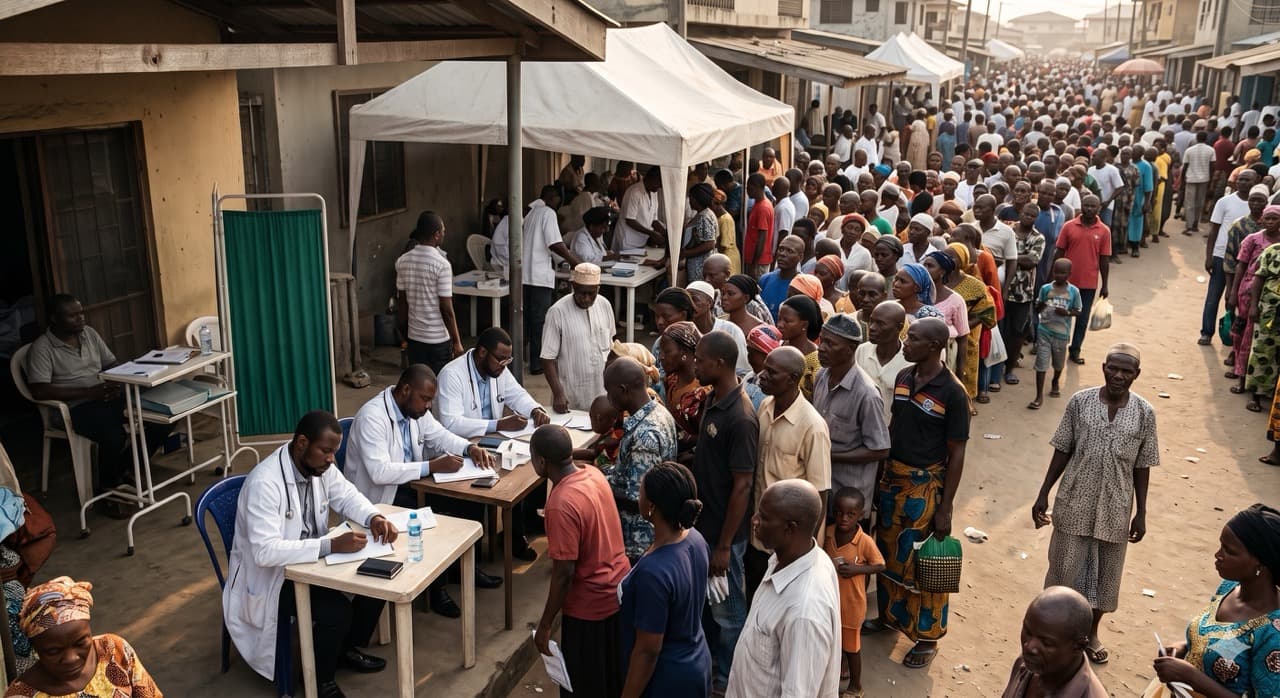
Nigeria has over 130,000 registered doctors but only about 55,000 actively practising. Here is why the doctor shortage is getting worse in 2026, and what it means for you as a patient.
The Numbers Behind Nigeria's Doctor Shortage in 2026
Nigeria has more than 220 million people and somewhere between 55,000 and 66,000 doctors actively practising within its borders. Do the math and you land somewhere between one doctor for every 3,600 people and one for every 4,000. The World Health Organisation recommends one doctor for every 600 people. Nigeria is not close, and the gap is widening every year.
In June 2026, the President of the Nigerian Medical Association, Prof. Omoti Ernest, confirmed to Vanguard that the Medical and Dental Council of Nigeria has registered over 130,000 doctors in total, but only about 55,000 remain actively practising inside the country. The rest have either emigrated, retired, moved into non-clinical roles, or stopped practising altogether. This is the doctor shortage Nigeria is grappling with in 2026, and it is not a future risk. It is the present reality every time you walk into a hospital and wait hours to see someone.
Why This Is Called Japa, and Why It Is Accelerating
"Japa" is Yoruba slang that loosely translates to "to flee" or "to run." It has become the catch-all term for the wave of Nigerian professionals, especially doctors, leaving the country for the United Kingdom, Canada, the United States, and Gulf states. It is not a new phenomenon, but the scale has reached a point where it now shapes national health policy conversations.
According to the Coordinating Minister of Health and Social Welfare, Prof. Muhammad Ali Pate, Nigeria lost approximately 15,000 to 16,000 doctors to migration over the past five to seven years. Some estimates from medical associations put the combined loss of doctors and nurses since the Japa wave began at around 94,000 health workers. In 2024 alone, the Medical and Dental Council of Nigeria registered about 4,900 new doctors and dental surgeons. In the same year, 4,200 doctors requested certificates of good standing, the document required to register and practise abroad. Nearly as many doctors were preparing to leave as were entering the system.
What is actually driving doctors away
The reasons doctors give for leaving are remarkably consistent, whether the conversation happens in Lagos, Abuja, or Kano. Poor and often delayed remuneration sits at the top of almost every list, compounded by a naira that has lost significant value against the currencies doctors would earn abroad. Beyond pay, doctors cite overwhelming patient loads, with some resident doctors reporting ratios above 1 to 10,000 in certain facilities. Many training hospitals lack modern equipment, including basic simulation tools used for specialist training, and importing that equipment has become prohibitively expensive as the naira has weakened.
Security is a growing concern as well. Several resident doctors have been kidnapped in recent years, and insecurity in parts of the country has made postings to certain regions a genuine personal risk rather than just a professional inconvenience. Limited opportunities for career advancement, long and unsafe working hours, and a general sense that the system does not value the people keeping it running round out the list.
What the Shortage Looks Like Inside a Nigerian Hospital
Statistics on a page are one thing. The lived experience inside Nigerian public hospitals is another. In June 2026, the Guardian reported on Oshodi-Isolo Primary Health Centre in Lagos, where a patient named Busayo Ajayi arrived at 8:45am with severe body pain and was still seated on the same wooden bench by 2:00pm. She had waited almost five hours, and only one doctor was on duty for the entire facility that day.
This is not an isolated story. The National Association of Resident Doctors put Nigeria's doctor-to-patient ratio at 1 to 9,083 in an October 2025 statement, noting that with an estimated population of over 240 million people, the country has only about 11,000 resident doctors carrying a disproportionate share of hospital workloads. Officials at one Lagos facility have said that nearly 98% of doctors who leave the state migrate abroad entirely, while others relocate to states with stronger security or more competitive pay.
The consequences ripple outward. Exhausted doctors working beyond recommended call durations are more prone to burnout and error. Patients face longer waits, rushed consultations, and in the worst cases, no doctor available at all. Specialists are stretched so thin that consultants are sometimes forced to abandon higher-level work, including research and complex specialist care, just to cover frontline gaps left by departing colleagues.
The Ripple Effect on Mental Health and Specialist Care
The shortage does not hit every specialty equally, and mental health care has been hit particularly hard. At a June 2026 conference held by the Association of Resident Doctors at the Federal Neuropsychiatric Hospital in Yaba, Lagos, doctors raised alarm that the country's manpower crisis is worsening psychiatric care access. They cited a striking figure: roughly 85% of Nigerians living with mental health disorders lack access to treatment. As experienced psychiatrists leave the country, the few who remain are forced to take on heavier caseloads, leaving less time for the kind of sustained care that mental health conditions require.
Similar strain shows up across other specialties. The Nigerian Medical Association has repeatedly called for the establishment of specialist hospitals across Nigeria's six geopolitical zones, arguing that without them, patients will keep travelling abroad for care that should be available at home, driving up Nigeria's medical tourism bill and further depleting confidence in the local system.
Is There a Way Back? The Japa-Japada Question
Alongside Japa, researchers have started talking about "Japada," the idea of doctors who left eventually returning home with new skills, international experience, and capital. A 2025 academic study published in the Journal of Migration and Health introduced the "Japa-Japada" framework to study what factors might draw Nigerian doctors back, alongside the factors pushing them out.
The honest answer is that reverse migration remains limited and under-resourced. Professor Peter Ndidi Ebeigbe, immediate past President of the National Postgraduate Medical College of Nigeria, told Vanguard in March 2026 that improving remuneration, stabilising the naira, and investing in modern medical equipment are the clearest paths to keeping doctors in the country and, eventually, attracting some back. Until those structural changes happen at scale, the doctors who remain in Nigeria will continue carrying a workload the system was never designed to put on so few shoulders.
What This Means for You as a Patient
You cannot personally fix Nigeria's doctor shortage. But you can make smarter decisions within the system as it exists today, and those decisions matter more now than ever.
Knowing which hospitals near you are adequately staffed, rather than discovering it after a five-hour wait, saves time you may not have in an emergency. Knowing which facilities have specialists on site for your specific condition, instead of being referred from hospital to hospital, can be the difference between timely treatment and dangerous delay. And knowing in advance which hospitals accept your NHIA insurance means you are not paying out of pocket on top of an already stretched system.
This is exactly the gap Medicall is built to close. Our verified healthcare directory helps you find hospitals and clinics across Nigeria based on your location, the specialist care you need, and your insurance coverage, so you spend less time searching and more time getting the care you actually need.
Find a verified hospital with the right specialists near you on Medicall.
Frequently Asked Questions
How many doctors does Nigeria have in 2026?
The Medical and Dental Council of Nigeria has registered over 130,000 doctors in total, but the Nigerian Medical Association estimates that only about 55,000 are actively practising within Nigeria. The rest have emigrated, retired, or moved out of clinical practice.
What is Japa and why does it affect healthcare in Nigeria?
Japa is a Yoruba term meaning to flee or run, used in Nigeria to describe the wave of professionals, particularly doctors and nurses, emigrating for better pay and working conditions abroad. It affects healthcare directly because it removes trained medical professionals from a system that is already short-staffed, leading to longer wait times and reduced access to specialist care.
What is Nigeria's doctor-to-patient ratio?
Estimates vary depending on the source and the population figures used, but they generally range from about 1 doctor for every 3,600 to 4,000 people based on NMA estimates, to 1 doctor for every 9,083 people based on a 2025 statement from the National Association of Resident Doctors. Either figure is far below the World Health Organisation's recommended ratio of 1 doctor per 600 people.
Why are Nigerian doctors leaving the country?
The most commonly cited reasons include poor and delayed remuneration, a weak naira that makes foreign salaries more attractive, overwhelming patient loads, inadequate medical equipment, limited career advancement opportunities, insecurity, and long, unsafe working hours without adequate rest.
How can patients cope with the doctor shortage in Nigeria?
Patients can reduce the impact of the shortage by identifying well-staffed hospitals with the right specialists before they need care, rather than discovering gaps during an emergency. Using a verified healthcare directory like Medicall to search by location, specialty, and insurance coverage helps patients find appropriate care more efficiently within a stretched system.